How a Septic System Works (Plain-English Guide)
The system nobody explains until it breaks
Buy a house on septic and you become the owner of a small wastewater treatment plant. It’s buried in the yard, it runs on gravity and bacteria, and nobody hands you a manual. For most owners, the first real explanation comes from a contractor, mid-crisis, with a bill attached.
This page is the manual. Plain language, no sales pitch, the whole system from the drain to the dirt.
It’s worth ten minutes because every septic decision gets easier once you know what’s under the grass. You’ll see why pumping the tank on schedule protects the most expensive part of the system instead of being busywork. You’ll know what a wet spot over the trenches might mean, and when it’s time to order a professional evaluation rather than guess. Most usefully, you’ll be harder to scare. In this trade, the owner who understands the system holds the pen.
Around Olympia the manual matters more than most places. Step outside the sewered core and septic is simply how homes work, on the peninsulas, along the inlets, and across the acreage lots that fill unincorporated Thurston County. No utility crew is coming. You’re the operator.
From the drain to the dirt, stage by stage
Everything you flush or rinse leaves the house through one pipe. Follow it.
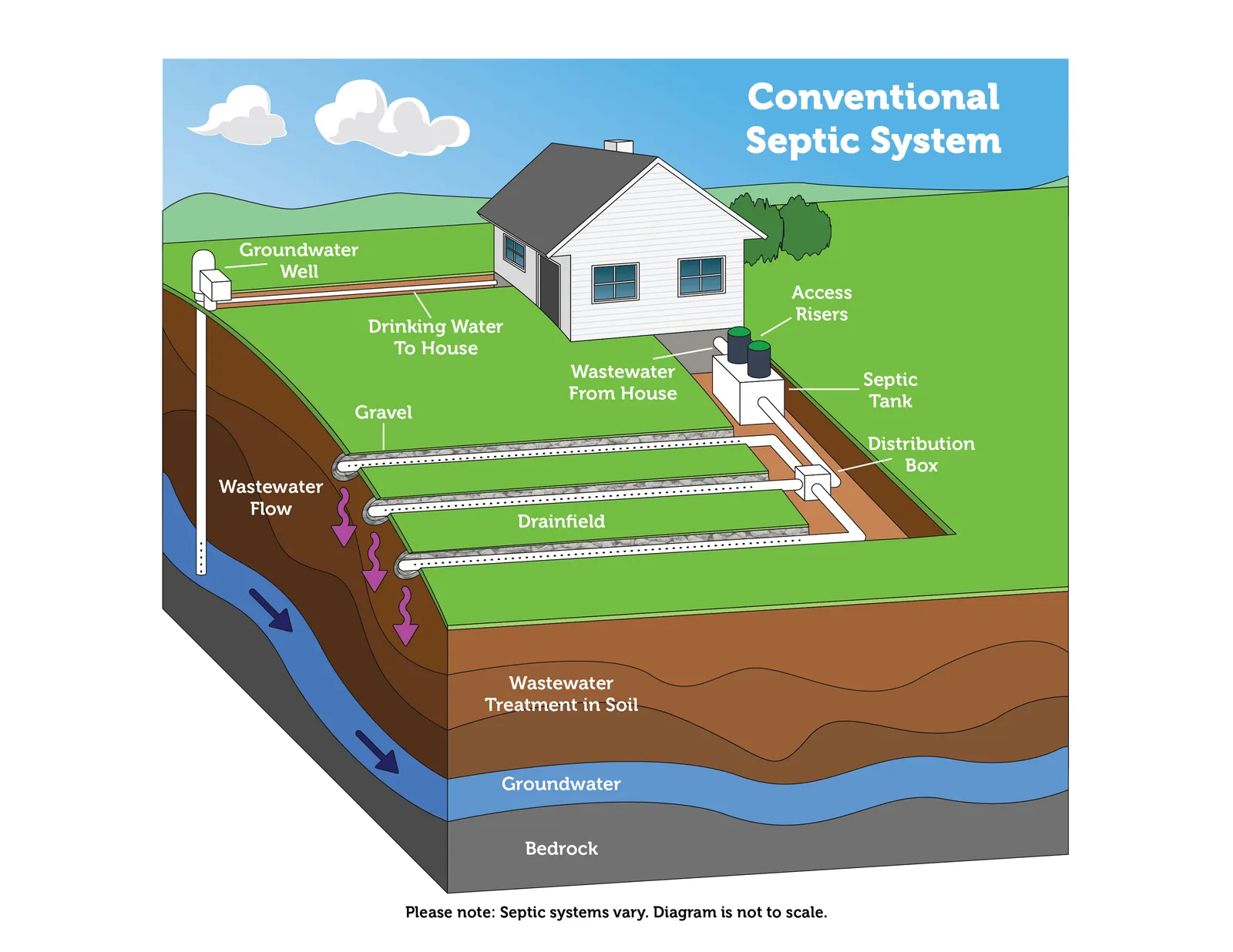
First stop is the septic tank, a buried, watertight box, usually concrete, commonly holding 1,000 to 1,500 gallons. The tank’s whole trick is stillness. Wastewater sits, and gravity sorts it into three layers. Heavy solids sink and become sludge. Fats and grease float into a top crust called scum. The partly cleared water in the middle is effluent, and it’s the only layer meant to leave.
Two fittings police the doors. The inlet baffle pushes incoming water down so it doesn’t shoot across the tank. The outlet baffle, often paired with an effluent filter, holds back the scum so only the middle layer exits. When a baffle rusts away, solids escape, and the damage lands downstream.
Next, on many systems, comes the distribution box, a small chamber that splits the flow evenly between pipes. Even matters. A box that settles out of level sends everything to one trench and wears it out years early.
Then the drain field, the part that does the disposing. Perforated pipes run through gravel-filled trenches. Effluent seeps out, and the soil beneath finishes the treatment. Soil microbes eat what the tank couldn’t settle out, and by the time water reaches groundwater it has been filtered and cleaned by several feet of ground.
The field is also where systems die. Wherever effluent meets soil, a dark microbial layer called the biomat forms. Thin, it helps treatment. Fed escaped solids for years, it thickens into a seal, and water that can’t soak away goes the only directions left: up into the yard or back toward the house. Water volume kills fields too. Every field is sized for a daily flow, and a running toilet or a saturated winter water table can push it past capacity.
None of this is visible from the lawn, which is why the trade settles questions by opening the tank and looking rather than theorizing from the grass.
Want to know what shape your system is in?
Gravity, pumps, mounds, and the rest
Not every yard gets the classic setup. The industry works with a range of designs, and the property dictates the pick.
Conventional gravity systems are the simplest: tank, distribution box, trenches, no moving parts. They need deep, well-drained soil, and they’re what most of Thurston County’s older acreage homes run.
Pressure distribution adds a pump chamber after the tank. The pump doses effluent through small holes under pressure, spreading it evenly when the site can’t rely on gravity. This is the standard around here for lots on glacial till or with seasonal high water.
Mound systems and sand filters go further, building or importing the soil the site lacks. A mound raises the drain field above a high water table. A sand filter runs effluent through a treatment bed before it reaches the ground.
Advanced treatment units add active biological treatment in a tank, producing cleaner water where sites are small or sensitive. Near shellfish waters like Henderson Inlet, cleaner effluent isn’t a luxury, and these designs show up often.
What decides? Soil, water table, space, and slope narrow the menu, and the county’s rules set the requirements. The guide to local septic rules covers that side. The short version: if your system has a control panel and an alarm, it has a pump, and it expects more attention than a gravity system.
What the anatomy tells you about care
Once you can see the system in your head, care stops being a list of rules and becomes obvious.
Solids build up in the tank no matter what you do, so the tank gets pumped before sludge reaches the outlet. That single habit protects the drain field, the one component that can’t be cheaply revived. The pumping frequency guide covers how to find your interval instead of borrowing a neighbor’s.
Baffles, filters, and pumps wear out quietly, so the system gets looked at periodically, with levels measured and components checked, and problems caught while they’re parts instead of projects.
And the field stays healthiest when the tank does its job, which is mostly about habits. What goes down the drain, how water use spreads across the week, what gets parked or planted over the trenches. The septic do’s and don’ts page puts the whole list in one place, short enough for the refrigerator door.